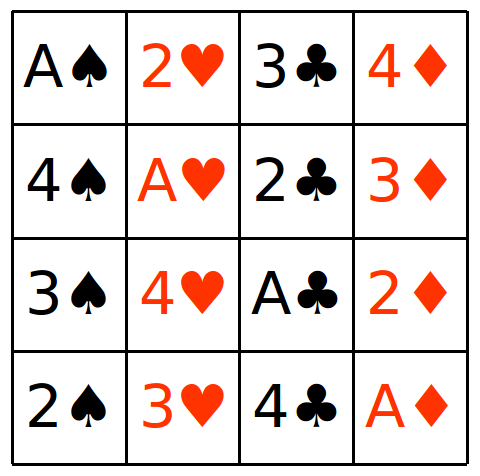
The past few days, my kids have been arguing about what game to play after school. The younger one wants to play Junior Monopoly but the older one thinks that’s too boring. The elder one wanted to play Blokus, but the younger one said that was too difficult.
Keep This In Mind
When reading the news, keep in mind that just because two things change together, doesn’t mean there’s any direct causal link.
7 Billion
According to official sources, the world’s 7 billionth person was born today. This is a fiction. The goal is to raise awareness about the world’s population. It’s working – the news seems to be all over the blogosphere.
The Hitch-Hiker’s Guide to Mathematics
To paraphrase Douglas Adams, “There is a theory which states that if ever anyone discovers the foundations of mathematics to be contradictory, they will instantly disappear and be replaced with something even more bizarre and inexplicable. There is another theory which states that this has already happened”
No More Money for British Maths
The EPSRC, or “Engineering and Physical Sciences Research Council” is the body in the UK that decides what kinds of research in the physical sciences will get government grant money. Grant money is needed for advanced research in mathematics for the following reasons :
- This kind of research produces amazing benefits down the track, however
- The benefits come too slowly for the private sector to be interested in funding research
The Math Of “Collect All 12″
“Free toy in every pack! Collect all 12!”
Have you ever wondered why companies offer promotions like this? How many packets of cereal would you have to buy to have a decent chance of collecting all twelve? Let’s see what the math says!
A Child’s View of Standardized Testing
My son was asked to write a short essay on standardized testing. I thought I’d share it with the world. Note that these are his opinions, not mine!
I’ve edited it slightly for clarity.
Dice and Polynomials – Part 2
In my last blog post, I explained how to quickly and easily work out, say, the number of ways to get a 10 on three dice, just by multiplying together some polynomials. It doesn’t have to be real dice of course. The trick works just as well for spinners, balls in a hat, or computer random number generators.
Dice and Polynomials – Part 1
Imagine you have two coins. One side is blank, and one has a single dot. You flip the coins. How many ways can you get 0 dots? How many ways can you get 1 dot? How many ways can you get 2 dots?
If you got answers like “1 way / 2 ways / 1 way” you got it right.
7 Is Not Prime, and Fermat’s Last Theorem
I was reading a book about numbers recently, and almost put it down when it started talking about prime numbers. The author had tried to work out the prime factors of 72, got as far as 2 x 2 x 2 x 9, then said “you guessed it, 9 is a prime number!” Arrgh!